
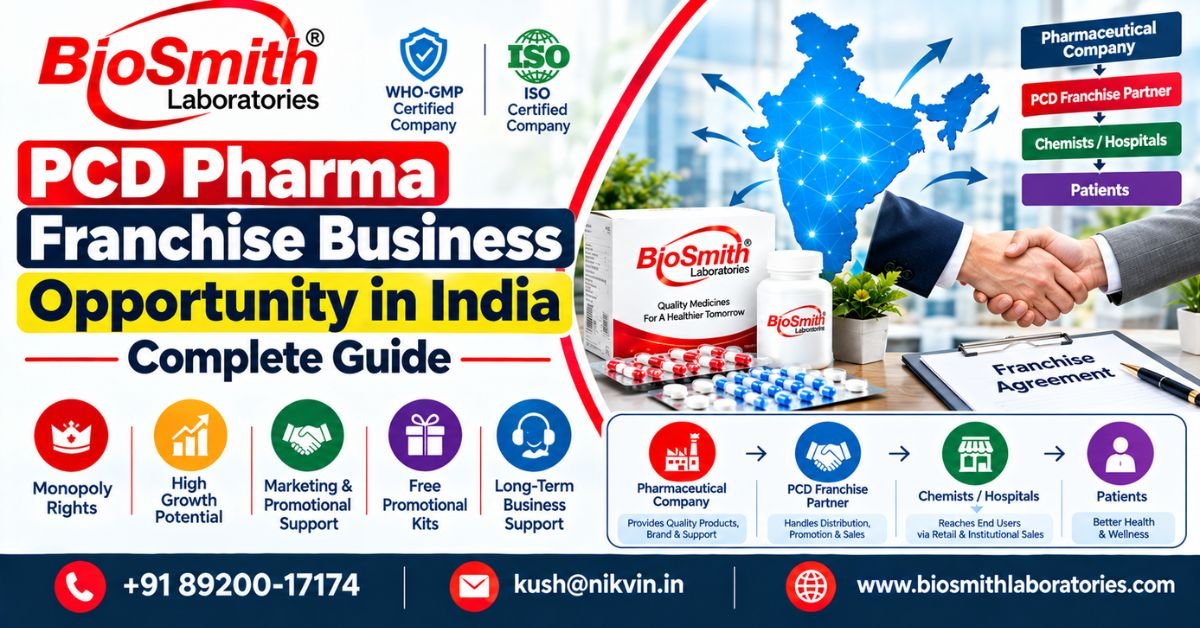
Written by the Biosmith Laboratories franchise desk · Last updated 28 September 2026 | PCD Pharma Franchise Business Opportunity
Featured Snippet Box
What is a PCD pharma franchise business opportunity in India? A PCD pharma franchise business opportunity in India lets you market and distribute a pharmaceutical company’s products in an agreed territory without owning a manufacturing plant. Before signing, verify the company’s licences, get territory and monopoly terms in writing, budget for stock, compliance and working capital, and confirm which drug licence your activities require.
A PCD pharma franchise lets you sell a pharmaceutical company’s products in a set territory while you build the local business yourself. No factory needed. What you do need is the right licence for whatever you’ll actually handle, a budget that survives a slow quarter, and an agreement you’ve read line by line.
PCD stands for Propaganda Cum Distribution. The company supplies the products and agreed support; you find buyers, take orders, coordinate deliveries and keep customers coming back. The entry barrier is lower than manufacturing, which is exactly why people rush in. Most of the trouble starts there, with partners who skipped the checking.
Below: how the model works, who it suits, how to size up a company, what it really costs, how monopoly rights behave on paper versus in practice, and the licensing questions to settle first.
What Is a PCD Pharma Franchise?
Short answer: A PCD pharma franchise is an agreement under which a pharmaceutical company authorizes a partner to market and distribute specified products in an agreed territory.
The partner doesn’t make the medicines. The company does, or a properly licensed third-party manufacturer does on its behalf. Beyond that, the contract and the law decide who does what, so two franchises from two companies can feel very different day to day.
How the Business Model Works
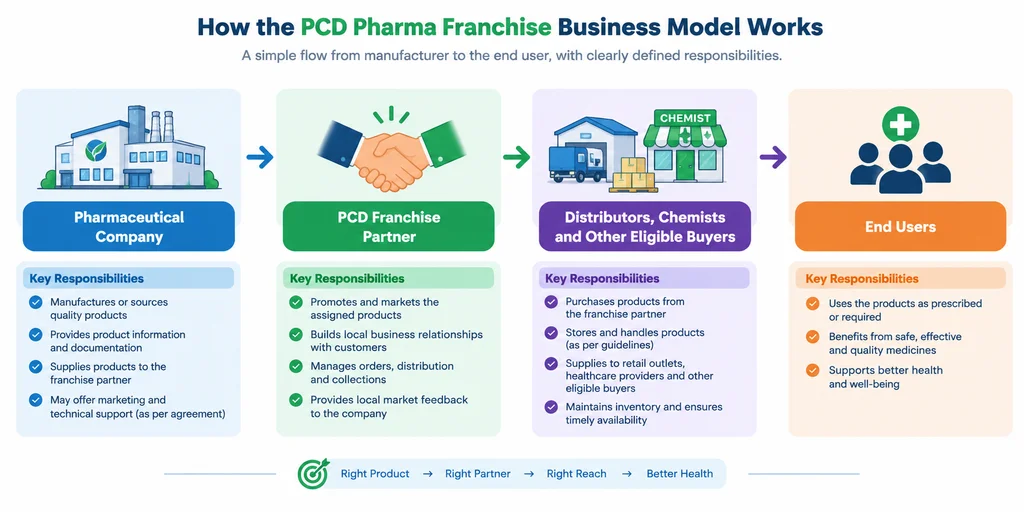
Short answer: Products move from the pharmaceutical company to the franchise partner, then to distributors, chemists and other eligible buyers, and finally to end users.
The company covers supply: making or sourcing the products and getting them delivered. The franchise partner covers the local side, which means relationships, orders, coordination and after-sale service in the territory.
Who Can Start One?
Short answer: Distributors, wholesalers, medical representatives, sales-minded entrepreneurs and existing pharma businesses all consider PCD franchises, but sales experience alone doesn’t authorize anyone to stock or sell medicines.
People get this wrong more than anything else. Years as a medical representative make you good at selling; they don’t stand in for a drug licence. If you plan to stock, sell or wholesale medicines, look up your state’s licensing rules before you start. And if your role is purely a marketing arrangement, your obligations may be lighter, but check rather than assume.
How to Choose a PCD Pharma Company
Short answer: Pick on documentation, supply reliability and clear written terms. Promised margins, low investment and the word “monopoly” are poor reasons to sign.
Five things deserve your time.
Product quality and documentation.
Ask for product details, manufacturing information, licences and quality documents, then match them to the products you’d really be selling. A licence covering one category doesn’t cover another. A verbal assurance isn’t a document.
Product range and local demand.
A bigger catalogue isn’t a better one. Look at what sells in your territory, who already supplies it, and what storage and shelf life each product needs. Ten products you can move beat a hundred you can’t.
Supply reliability.
How long do orders take? What’s the minimum order? What happens when something’s out of stock, or arrives damaged or wrong? Patchy supply wrecks customer relationships even when demand is strong.
Promotional support.
Find out exactly what’s included (catalogues, approved material, product information, order coordination) and what costs extra. Whatever promotion you run has to follow pharmaceutical marketing and advertising rules.
Agreement terms.
Minimum purchase commitments, payment deadlines, renewal, termination, and what happens to unsold or expired stock. That last one decides more outcomes than people expect.
Evaluation checklist
- [ ] Verify the company’s legal identity and relevant licences.
- [ ] Review the product portfolio and its documentation.
- [ ] Get the proposed territory and products confirmed in writing.
- [ ] Obtain a full breakdown of initial and recurring costs.
- [ ] Understand order, payment and delivery terms.
- [ ] Read the returns, expiry and damaged-stock policies.
- [ ] Confirm the promotional support actually provided.
- [ ] Read the whole agreement before paying anything.
Red Flags Before You Pay Anything
Short answer: Guaranteed profits, vague territory terms, pressure to pay fast and reluctance to show licence documents are the clearest warning signs in a PCD pharma franchise offer.
| What you hear or see | Why it matters | What to ask for |
|---|---|---|
| “Guaranteed” returns or sales volumes | No company can promise results that depend on your market and your execution | Terms with no outcome guarantees you can’t verify |
| “Monopoly” with no territory or product detail | The word has no legal weight; the contract does | Exact territory, product list, duration and exclusions in writing |
| Pressure to pay a deposit before you’ve seen the agreement | You can’t assess terms you haven’t read | The full agreement first, payment second |
| Hesitation to share licences or product documents | Documents are how you verify what you’d be selling | Licence copies and product documents matching the products offered |
| No clear policy on expired or damaged stock | Unsold stock is a normal part of this business | A written returns and expiry policy |
What a PCD Pharma Franchise Costs
Short answer: There’s no single investment figure, because cost depends on opening stock, licensing status, location, product range and the company’s commercial terms.
Anyone quoting one “standard” number is simplifying. Build your own budget, and get a written quotation that separates mandatory costs from optional ones, including whether quoted amounts cover taxes and transport.
| Cost category | What to work out |
|---|---|
| Initial stock | Required products, quantities and minimum order value |
| Licensing and compliance | Licence application costs, premises requirements, professional fees |
| GST and accounting | Registration where required, bookkeeping, tax compliance |
| Storage and operations | Suitable premises, handling, transport, running costs |
| Sales and marketing | Travel, communication, permitted promotional activity |
| Working capital | Cash to cover orders, payment cycles and expenses while money is still owed to you |
Working capital is the line people underestimate. It’s the cash that keeps you running between buying stock and getting paid for it.
Also Read :- PCD Pharma Franchise Cost in India & Panchkula: Complete Guide
Why a 20% Markup Can Still Lose Money
Short answer: Net operating profit equals sales revenue minus cost of goods sold minus operating expenses, so expired stock and running costs can turn a healthy-looking markup into a loss.
Here’s a made-up example. The numbers show the mechanics; they don’t predict anyone’s results.
| Item | Amount (₹) |
|---|---|
| Stock bought | 1,00,000 |
| Stock sold (at cost) | 90,000 |
| Sales revenue from that stock (20% above cost) | 1,08,000 |
| Stock that expired unsold (at cost) | 10,000 |
| Operating expenses (travel, storage, communication, compliance) | 12,000 |
| Net result | 1,08,000 − 90,000 − 10,000 − 12,000 = −4,000 |
A 20% markup on everything sold, and the business still ends up ₹4,000 down. Ten percent of the stock expired and expenses ate the rest. Now stretch customer payments from 30 days to 60 and you get a cash crunch even in months when the books look fine.
So judge an opportunity on sales mix, purchase terms, discounts, inventory losses, collection periods and running costs together, never on the gap between buying and selling price alone. No company can guarantee profit or sales volume for every partner.
PCD Pharma Monopoly Rights Explained
Short answer: PCD pharma monopoly rights are contractual arrangements giving a partner defined territory or product marketing and distribution rights, and their real protection depends entirely on what the agreement says.
A contract might, say, allocate certain products to you for one district. How much protection that gives you turns on scope, exclusions and whether the terms are enforceable. “Monopoly” in a brochure isn’t exclusivity in an agreement.
Get answers in writing to these before you accept:
- Which exact territory is covered?
- Which products or categories are included?
- Are existing customers or accounts excluded?
- Are there minimum purchase targets, and what happens if you miss one?
- How long do the rights last, and can they be renewed, changed or terminated?
- What happens if either side breaches the agreement?
Look hardest at the minimum purchase targets. Exclusivity you lose when you miss a target is conditional exclusivity, and it should be priced that way.
Drug Licence and Legal Requirements
Short answer: Whether a PCD pharma franchise needs a drug licence depends on the activities involved, and any business that stocks, sells or wholesales medicines should confirm its requirements with the State Licensing Authority before starting.
According to the Drugs and Cosmetics Rules, 1945, different licence forms apply to different wholesale drug activities. Forms 20B and 21B cover wholesale of different categories of drugs, so the right one depends on the products you’ll handle. Confirm the exact form and conditions with your State Licensing Authority.
Also check:
- Premises requirements for the licence.
- Qualification or experience requirements for the designated competent person, where applicable.
- GST registration and invoicing obligations.
- Business registration and accounting requirements.
- Storage, record-keeping and supply conditions.
- Pharmaceutical marketing and advertising rules.
Obligations differ from partner to partner. Someone in a marketing-only arrangement can face different requirements from a business that stocks and wholesales medicines.
For authoritative guidance, go to the Central Drugs Standard Control Organization (CDSCO) and your state drug licensing authority. If your structure or licensing position is unclear, talk to a qualified professional before committing money.
How to Start: Step by Step
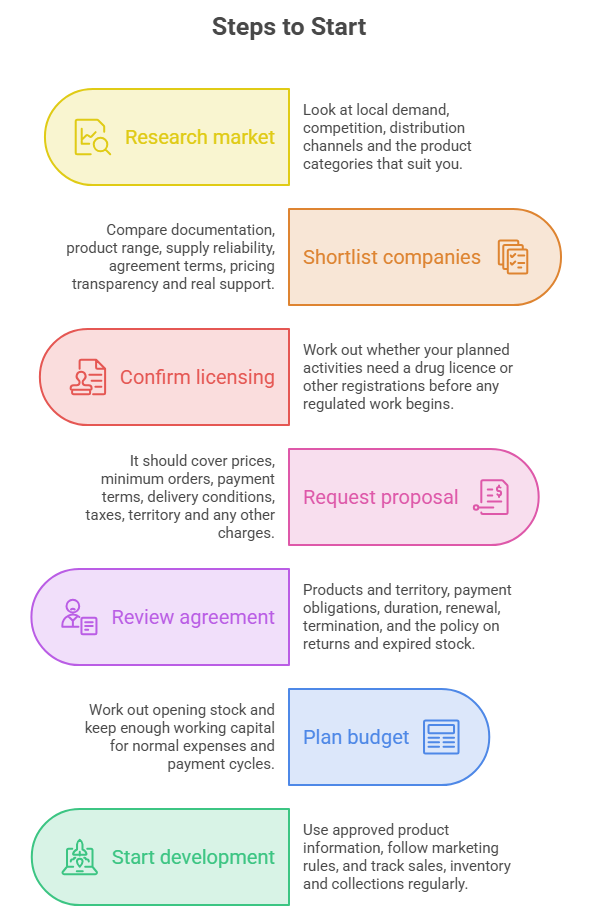
Short answer: Research your market, shortlist companies, settle licensing, get a written proposal, review the agreement, plan your budget, then begin compliant business development, in that order.
- Research your market. Look at local demand, competition, distribution channels and the product categories that suit you.
- Shortlist companies. Compare documentation, product range, supply reliability, agreement terms, pricing transparency and real support. Ignore the promotional promises.
- Confirm your licensing position. Work out whether your planned activities need a drug licence or other registrations before any regulated work begins.
- Request a written commercial proposal. It should cover prices, minimum orders, payment terms, delivery conditions, taxes, territory and any other charges.
- Review the agreement. Products and territory, payment obligations, duration, renewal, termination, and the policy on returns and expired stock.
- Plan the budget and first order. Work out opening stock and keep enough working capital for normal expenses and payment cycles.
- Start compliant business development. Use approved product information, follow marketing rules, and track sales, inventory and collections regularly.
What to Ask Biosmith Laboratories
Short answer: Before committing to Biosmith Laboratories, ask directly for the product catalogue, territory availability, opening order and payment terms, delivery policies, promotional support details and licensing information.
Biosmith Laboratories offers a pharmaceutical business platform for people exploring PCD pharma franchise opportunities. Confirm commercial terms, territory availability, supply arrangements and support with the company itself. Specifically, ask for:
- The current product catalogue and product documentation.
- Available franchise territories and product allocation.
- Opening order and payment requirements.
- Delivery and stock-handling policies.
- Promotional support and agreement terms.
- Applicable licensing and compliance information.
Set those answers against everything above and decide on the actual offer, not on assumptions. You can read about the company’s franchise offering on the Biosmith Laboratories PCD Pharma Franchise page, then contact the company about availability and terms for your intended territory.
Key Takeaways
- A PCD pharma franchise lets you market and distribute a pharmaceutical company’s products in an agreed territory without running a factory.
- Licensing follows what you do. Stocking, selling or wholesaling medicines generally needs the right drug licence, so check with your State Licensing Authority first.
- “Monopoly rights” mean only what the written agreement says about territory, products, duration and conditions.
- There’s no standard investment figure. Budget for stock, compliance, operations, marketing and working capital, and get a written quotation.
- Expired stock, discounts and late payments can wipe out a margin that looks healthy on paper.
- Read the whole agreement, and don’t pay before you have.
FAQs
1. What is a PCD pharma franchise business opportunity?
It’s an arrangement in which a pharmaceutical company authorizes a partner to market or distribute specified products under agreed terms, subject to applicable legal requirements.
2. How much investment does a PCD pharma franchise need?
It varies with opening stock, product range, location, operating costs, licensing needs and the company’s terms. Ask for a detailed written quotation before deciding.
3. Is a drug licence required for a PCD pharma franchise?
It depends on your activities. Businesses that stock, sell or wholesale medicines may need appropriate licences, so confirm your requirements with the relevant licensing authority.
4. What’s the difference between PCD pharma and pharmaceutical manufacturing?
A PCD franchise partner generally handles agreed marketing or distribution. Manufacturing means producing medicines under an appropriately licensed arrangement.
5. What are monopoly rights in a PCD pharma franchise?
They’re contractual rights that may allocate a defined territory or product range to a partner. Their scope and limits must be confirmed in the written agreement.
6. How do I pick a reliable PCD pharma franchise company?
Verify the company’s identity and documents, review product quality and availability, check supply reliability, compare commercial terms, and read the agreement before paying.
7. Can a PCD pharma franchise guarantee profits?
No. Results depend on demand, pricing, expenses, competition, inventory management and collections, so treat projected margins as estimates.
8. What should I check before placing my first order?
Confirm the product list, quantities, prices, taxes, payment terms, delivery schedule, shelf life, storage needs, and the policy for damaged or expired stock.
9. Is a PCD pharma franchise a good business?
It can be, if you have a real local market, the right licences, enough working capital and a fair agreement. It tends to disappoint people who enter on margin promises alone.
10. What should I do after reading a franchise agreement?
Compare its territory, product, payment and termination terms with the written quotation, and consider professional advice before signing if anything is unclear.
Author Box
Biosmith Laboratories publishes educational content for people exploring PCD pharma franchise opportunities in India and offers a pharmaceutical business platform for prospective partners. Readers should confirm product availability, territory terms and licensing requirements directly with the company and the relevant authorities.
Disclaimer :-
This article provides general educational information, not legal, tax or financial advice. Licensing, tax and marketing requirements vary by activity and applicable rules. Verify current requirements with the relevant authorities before starting operations.