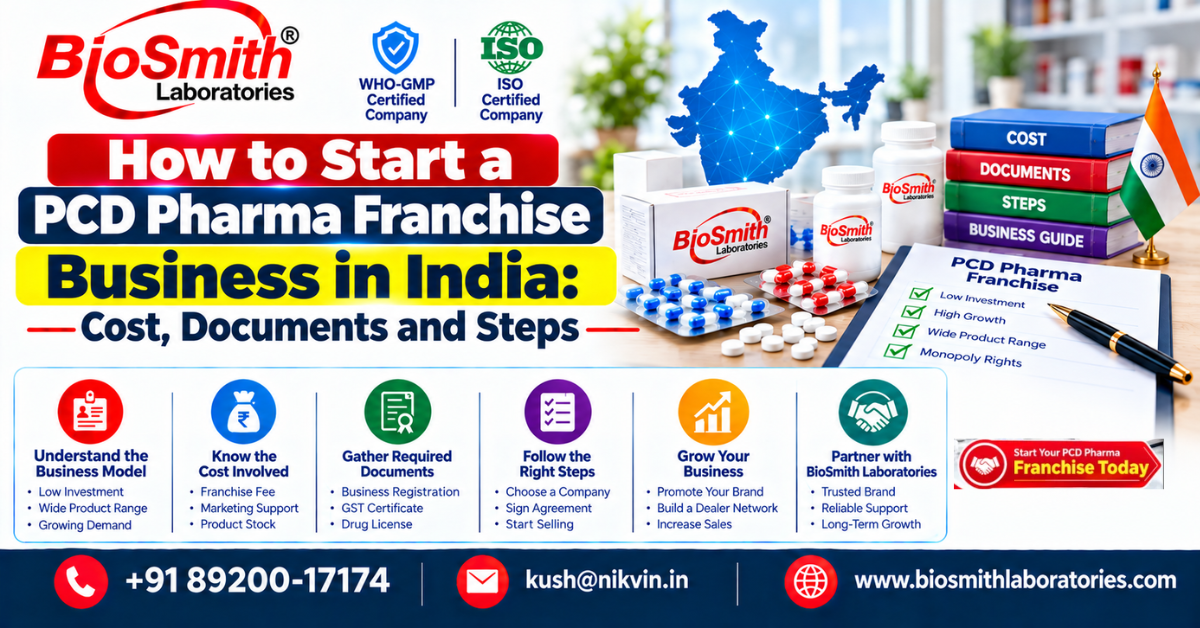
Quick answer: To start a PCD pharma franchise in India, choose a manufacturer with a valid manufacturing licence, get a wholesale drug licence (Forms 20B and 21B) and a GST registration, sign a written territory agreement, then place a small first order of fast-moving products. Most small starts need roughly ₹40,000–₹1,00,000, depending on the company and territory.
A PCD (Propaganda cum Distribution) franchise lets you sell a pharma company’s branded medicines in your own territory without owning a factory. The company manufactures, tests and gets approvals. You promote to doctors, supply chemists and earn the trade margin. This guide covers the cost, the documents and the seven steps, using the current wholesale licence rules.
What is a PCD pharma franchise business?
Takeaway: A PCD pharma franchise is a distribution agreement. The pharma company owns the products and the factory; the franchise partner owns the sales effort in an agreed territory.
PCD stands for Propaganda cum Distribution. “Propaganda” here means promotion: meeting doctors, giving samples and building prescriptions. “Distribution” means supplying those medicines to local chemists and stockists. The company usually grants territory rights, often called monopoly rights, so no other partner of the same company sells the same brands in your area.
The split of work is clear:
| Task | PCD company | You (franchise partner) |
|---|---|---|
| Manufacturing, batch testing, quality assurance | Yes | No |
| Product approvals and regulatory filings | Yes | No |
| Promotional material (visual aids, literature, samples) | Usually | Uses and distributes |
| Doctor visits and chemist supply | No | Yes |
| Wholesale drug licence and GST | No | Yes |
| Local stock, delivery and collections | No | Yes |
A PCD franchise is different from third-party manufacturing. In PCD, you sell the company’s existing brands. In third-party manufacturing, you launch your own brand and the company makes it for you, which needs more capital and brand-building.
The model suits medical representatives who already know doctors, chemists who want a wholesale line, and first-time business owners who want a lower-investment entry into healthcare. It does not suit someone who expects orders without field work. The business depends on regular visits.
PCD pharma franchise cost: how much do you need to invest?
Takeaway: A small PCD pharma franchise typically needs about ₹40,000 to ₹1 lakh to start, and the first stock order is the largest single item. These are planning estimates, not company quotes. The real figure depends on the company, product range and territory.
The table below splits the minimum PCD pharma franchise investment into its parts.
| Expense | Estimated cost | What it covers |
|---|---|---|
| Initial stock purchase | ₹20,000–₹50,000 | First order, set by the company’s minimum order quantity (MOQ) |
| Wholesale drug licence | ₹1,500–₹10,000 | Government fee starts at ₹1,500 (check your state portal for the exact challan), plus a consultant if you use one |
| GST registration | ₹0–₹3,000 | The government charges nothing; the upper figure is a consultant’s filing fee |
| Promotional materials | ₹5,000–₹15,000 | Visual aids, literature, sample kits, MR bag, if the company does not supply them free |
| Transport and logistics | ₹2,000–₹5,000 | Freight on incoming stock and local delivery |
| Working capital | ₹10,000–₹20,000 | Travel, fuel, phone and small day-to-day costs |
Added together, the rows come to about ₹38,500 at the low end and just over ₹1 lakh at the high end, which is why most companies quote ₹40,000 to ₹1 lakh.
Where the money actually goes
- Stock. Start with fast-moving products that doctors in your area already prescribe. Slow items expire on your shelf and lock up cash.
- MOQ. A lower minimum order quantity keeps the first investment small. Get the MOQ in writing before you commit.
- Licence fee. According to OkCredit’s 2026 summary of the Drugs Rules, 1945, the government fee for a standard wholesale application on Form 19 is ₹1,500, and Forms 20B and 21B can be applied for together. Consultant charges are separate, so ask for them as their own line. Since 2017 the licence stays valid without renewal as long as a retention fee is paid every five years.
- Hidden costs. Ask each company whether it charges a security deposit, franchise fee or training fee. Many do not, but the question costs nothing.
What the table leaves out
Monthly running costs keep coming after the first order: field travel, a medical representative’s salary if you hire one, samples, and the cost of expired stock. Keep a cushion for the first three months, because doctors rarely prescribe a new brand after one visit.
Documents required for a PCD pharma franchise
Takeaway: The one document that cannot be skipped is a wholesale drug licence (Form 20B and, for injectables and biologicals, Form 21B) from your State Drug Control Department, plus a GST registration. Everything else supports those two.
Exact checklists differ slightly between states, so confirm with your State Drug Control Department before you apply. Most states accept applications through the national online portal (ONDLS, statedrugs.gov.in), while a few run their own portals.
Which wholesale licence form do you need?
Under the Drugs Rules, 1945, a wholesale licence is applied for on Form 19 and issued as Form 20B or Form 21B.
| Form | Covers | Typical PCD products |
|---|---|---|
| Form 20B | Wholesale of drugs other than Schedule C, C(1) and X | Tablets, capsules, syrups, ointments |
| Form 21B | Wholesale of Schedule C and C(1) drugs | Vaccines, sera, many injectables and biological products |
A franchise whose range includes injectables usually needs both forms. Schedule X drugs (narcotic and psychotropic substances) need a separate licence, so most PCD partners avoid them. A retail licence (Forms 20 and 21) does not let you supply chemists in bulk, and a wholesale licence does not let you sell to patients across the counter.
Document checklist
| Document | Why it is needed |
|---|---|
| Wholesale drug licence (Forms 20B, 21B as applicable) | Legal permission to stock and sell medicines in bulk. Companies ask for a copy before they ship. |
| GST registration certificate | Needed to raise tax invoices and buy from the company. The government fee is nil. |
| PAN card | For tax filing, GST registration and a business bank account. |
| Identity proof (Aadhaar, passport or voter ID) | Of the proprietor, each partner or each director. |
| Constitution proof | Partnership deed, or company or LLP incorporation papers, if you are not a sole proprietor. |
| Premises proof | Ownership deed, or a registered lease deed if rented. The premises must be fit for commercial storage and measure at least 10 sq m (15 sq m if retail and wholesale licences share the premises). |
| Refrigerator and storage details | Needed for temperature-sensitive products such as vaccines and biological injectables, usually checked at inspection. |
| Qualified person’s documents | See below. |
Who can be the qualified person?
The wholesale licence requires medicines to be sold under the supervision of a registered pharmacist or another “competent person” as defined by the Drugs Rules. In general, that means a registered pharmacist, or a graduate with a year’s experience dealing in drugs, or a matriculate with four years’ experience. Your State Drug Control Department confirms what it accepts. You do not need a pharmacy degree yourself if you appoint a qualified person, but that person’s documents and appointment letter go with the application.
Licence validity
A licence in Form 20B or 21B stays valid indefinitely once granted, provided a retention fee equal to the original fee is paid before each five-year anniversary of issue. A late fee of 2% per month applies for up to six months, after which the licence is treated as cancelled. Put the date in your calendar on the day the licence arrives.
How long does the licence take?
Timelines depend on the state and on whether your premises pass inspection. Some licensing consultants quote roughly two to four weeks for a clean application, but that is an estimate, not a guarantee. Apply early, because the company cannot invoice you until the licence number is in hand.
How to start a PCD pharma franchise: step-by-step process
Takeaway: Pick the company and confirm your territory in writing before you spend on stock. The licence takes the longest, so apply for it early.
- Research the market. Find out which therapeutic segments are in demand in your district. Talk to local doctors, hospitals and chemists, and note which brands competitors push and where they fall short, such as stock-outs or slow delivery.
- Shortlist and verify PCD companies. Look at the manufacturer’s licence, quality certifications, product range, lead times and how it treats existing partners. The vetting checklist further down shows how to check each claim.
- Choose your product range. Match products to what doctors in your area already prescribe. Visit clinics and ask chemists which medicines move fastest, then start with a small, balanced list instead of the full catalogue.
- Apply for the drug licence and GST registration. File Form 19 with your State Drug Control Department for Forms 20B and 21B, and register for GST on the official portal, where the government fee is nil.
- Set up storage and your team. Arrange clean, dry shelving, a refrigerator if you will stock temperature-sensitive products, billing software and your qualified person. Inspectors check this before issuing the licence.
- Sign the agreement. Read every clause on territory rights, minimum order quantity, credit terms, return and expiry policy, pricing and exit. Anything not in writing is not guaranteed.
- Place your first order and start marketing. Order a small first batch of fast-moving products, collect the promotional kit (visual aids, sample boxes, MR bag), and start meeting doctors and chemists. Regular follow-up turns first orders into repeat orders.

How much can you earn from a PCD pharma franchise?
Takeaway: Your margin is the gap between buying and selling price. Your net profit is what remains after travel, samples, staff, storage, expired stock and tax, and it is always smaller. Nobody can promise a fixed income, because it depends on product mix, territory and how hard you work the market.
Take a simple case. You buy a medicine for ₹100 and sell it for ₹130, so your margin is ₹30. That ₹30 has to pay for everything it took to make the sale.
The illustration below scales that up. The numbers are invented to show the method, not a forecast. Replace them with your own company’s rates and your own costs.
| Monthly illustration | Amount |
|---|---|
| Stock bought from the company | ₹2,00,000 |
| Sales to chemists and stockists (at ₹130 per ₹100 bought) | ₹2,60,000 |
| Gross margin | ₹60,000 |
| Field travel and fuel | ₹8,000 |
| Medical representative’s pay | ₹15,000 |
| Samples and promotional top-ups | ₹4,000 |
| Storage, billing and phone | ₹3,000 |
| Expired or returned stock | ₹5,000 |
| Miscellaneous | ₹3,000 |
| Net profit before income tax | ₹22,000 |
In this example, about a third of the gross margin survives as profit. Three things move that number most: expiry losses, the credit you give chemists (cash tied up in unpaid bills) and how much of your own time replaces paid staff. GST is collected from customers and paid to the government, so it is not part of your profit. According to Ok Credit’s summary of the 56th GST Council decision, most medicines have been taxed at 5% since 22 September 2025, down from 12%; confirm the rate for your products with a CA.
How to choose a PCD pharma company and check the agreement
Takeaway: Choose the company before you spend money. A good partner shows verifiable licences, puts territory and return terms in writing, and does not promise guaranteed income.
Verify the manufacturer
- Manufacturing licence. Ask for the company’s manufacturing licence number and the address of the plant, then confirm it with the issuing state drug authority. Do not rely on a certificate image alone.
- GMP compliance. According to India Briefing’s report on the Health Ministry’s extension, small and medium manufacturers that filed upgrade plans had until 31 December 2025 to meet the revised Schedule M good manufacturing practice norms, so every licensed unit is now expected to meet them. Ask how the plant complies. WHO-GMP and ISO certificates are extra signals, not substitutes for the licence; ask for the certificate and check its validity date.
- Product permissions. Ask for the product list with composition and pack details. For combination products, check that each one is permitted for sale in India.
- Batch and invoice discipline. Every consignment should arrive with a tax invoice that carries batch numbers and expiry dates. Keep these records, because inspectors can ask for them.
What the agreement should say
| Clause | What to look for |
|---|---|
| Territory | The exact district or state, and whether rights are exclusive |
| Minimum order quantity | Amount and time period, in writing |
| Pricing | Price list, how often it can change, and notice period |
| Credit terms | Payment days, and what happens on late payment |
| Expiry and returns | Who bears loss on near-expiry or damaged stock, and how replacement works |
| Promotional support | Which materials are free and which are chargeable |
| Exit | Notice period and what happens to unsold stock |
Red flags
- A large “franchise fee” demanded before any written agreement
- No manufacturing licence number, or a reluctance to share it
- Promises of guaranteed income or a fixed monthly profit
- Prices far below the rest of the market with no explanation
- Territory rights described only on the phone or on a messaging app
One more check costs nothing: speak to two or three existing partners of the company, and ask about delivery time, expiry replacement and payment behaviour.
Start your PCD pharma business with Biosmith Laboratories
Takeaway: Biosmith Laboratories offers PCD pharma franchise opportunities across tablets, capsules, syrups and injectables, with territory rights and promotional support for partners.
Biosmith Laboratories is a PCD pharma franchise provider with a range that covers tablets, capsules, syrups and injectables. Franchise partners receive monopoly rights in their territory, along with marketing tools such as MR bags, visual aids, sample kits and product literature. The low-investment model is designed for both existing distributors and first-time entrants, and the company is expanding its network across North, South, East, West, Central and North-East India.
Before you sign with any company, including Biosmith Laboratories, use the vetting checklist above: ask for the licence details, the written territory terms and the MOQ. To discuss PCD pharma business opportunities with Biosmith Laboratories, call +91 89200-17174.
[Add here only if verified by Biosmith: manufacturing licence number, GMP or ISO certificate details, plant location and product count.]
Key takeaways
- A PCD pharma franchise lets you sell a manufacturer’s existing brands in your own territory without owning a factory.
- Plan roughly ₹40,000 to ₹1 lakh for a small start; stock is the biggest cost.
- A wholesale drug licence (Form 20B, plus Form 21B for injectables and biologicals) and a GST registration are the core documents. The government GST fee is nil.
- Choose the company first, verify its manufacturing licence, and get territory, MOQ and return terms in writing.
- Margin is not profit. Expiry losses, credit to chemists and field costs decide what you keep.
Conclusion
Starting a PCD franchise is less about money than about order. Verify the company, get the licence in hand, keep the first order small and fast-moving, and spend your first months building doctor and chemist relationships. Partners who rush into a large stock order before the paperwork is settled are the ones who struggle most. Choose the partner before you spend the money.
Frequently asked questions
Q1. Do I need a drug licence to run a PCD pharma franchise?
Ans. Yes. A wholesale drug licence is required to stock and sell medicines in bulk. Apply through your State Drug Control Department using Form 19.
Q2. What does PCD mean in pharma?
Ans. PCD means Propaganda cum Distribution. You promote a company’s products to doctors and distribute them to chemists in your area.
Q3. How much does it cost to start a PCD pharma franchise?
Ans. A small start typically needs about ₹40,000 to ₹1 lakh, covering first stock, licence, promotional material, logistics and working capital. The exact amount depends on the company’s MOQ and your territory.
Q4. How is a PCD franchise different from third-party manufacturing?
Ans. In a PCD franchise you sell products the company already makes. In third-party manufacturing you launch your own brand and the company manufactures it for you.
Q5. Do I need a pharmacy degree to start?
Ans. Not always. The wholesale licence needs a registered pharmacist or another competent person as defined by the Drugs Rules, and that person can be someone you appoint.
Q6. Is there a government fee for GST registration?
Ans. No. GST registration on the official portal is free. Only a consultant, if you hire one, may charge a filing fee.
Q7. How long is a wholesale drug licence valid?
Ans. Since 2017, Form 20B and 21B licences stay valid indefinitely as long as a retention fee is paid before the end of every five-year period from issue.
Q8. Which products sell best?
Ans. That depends on your area. General medicine, cardiac, diabetic, gastro and paediatric products are common choices. Study local prescribing patterns before you pick.
Q9. How much stock should I buy first?
Ans. Keep the first order small and focused on fast-moving products. Increase it once you see what your doctors and chemists reorder.
Q10. Can I run this business part time?
Ans. You can begin part time, but regular doctor and chemist visits drive results. Many owners move to full time as orders grow.
Q11. Do companies provide marketing support?
Ans. Many do, such as visual aids, literature, sample kits and MR bags. Confirm what is free and what is chargeable before you sign.
Q12. Can I get an exclusive district?
Ans. Often yes, but availability differs. Ask the company in writing whether your district is still open for exclusive rights.
Q13. How do I earn repeat orders?
Ans. Deliver on time, keep stock available and follow up with doctors and chemists. Trust builds slowly, and it brings steady reorders.
Q15. What mistakes should I avoid?
Ans. Avoid choosing a company only for low prices, signing without reading the agreement, and overstocking slow products. Confirm every term in writing.
Author box
Biosmith Laboratories is a PCD pharma franchise provider with a range covering tablets, capsules, syrups and injectables. To discuss franchise opportunities, call +91 89200-17174.